Key takeaways
- Safety first: keep guests, children and pets away, and keep electrical appliances away from water.
- Stop all water use at once: no showers, flushing, washing machines or dishwashers until the tank is emptied.
- Do not pour chemicals, bleach or additives into the cesspit or onto the spill.
- Take photos and short videos before cleaning; insurers and property owners will ask for them.
- Send us a WhatsApp with your location pin and access details on +30 693 673 2110; we usually reach you within 1 to 2 hours.
Step 1: Make the area safe
Raw sewage carries bacteria and viruses, and cesspits release gases that are unpleasant at best and dangerous in a closed space. Before anything else, protect people.
- Move guests, children and pets away from the affected area. Close doors to affected rooms and keep the pool area clear if the spill is nearby.
- Do not touch sockets, switches, extension leads or appliances that are in or near water. If water has reached electrical outlets or a plug-in pool pump, switch off that circuit at the main panel only if you can reach it from a dry place. If in doubt, call an electrician.
- Open windows and doors to ventilate indoor spaces. Do not light cigarettes, candles or anything with a flame near an open cesspit.
- Wear rubber gloves and closed shoes if you have to go near the spill, and wash your hands thoroughly afterwards.
- Never climb into a cesspit or lean deep into an open manhole. Gases inside can make a person lose consciousness within moments.
Step 2: Stop using water in the property
Every litre that goes down a drain ends up in the same full tank, and comes back out wherever the system is lowest: a shower tray, a floor drain or the garden.
- Ask everyone in the house to stop showering, flushing and running taps.
- Turn off washing machines and dishwashers, and pause any cleaning that uses water.
- If the pool backwash or an outdoor shower drains into the cesspit, stop those too.
- In a hotel, tell housekeeping and the kitchen straight away; a single laundry cycle can make an overflow much worse.
- If guests cannot avoid using the toilet, limit it to the bare minimum until we arrive.
Step 3: Find the cesspit lid and clear the access
You do not need to open the cesspit. You only need to know where it is, so our driver can get the hose to it as soon as they arrive.
Look for a concrete or metal cover in the garden, driveway or under a terrace slab. If you do not know where it is, check the house manual or ask the owner, the property manager or the builder. Move cars, planters, sunbeds or anything else blocking the lid or the drive, and open the gate. Many villa driveways in Mykonos are narrow or steep, so a clear path saves real time.
Step 4: What not to do
Some reactions feel helpful but make things worse.
- Do not pour bleach, caustic drain cleaners or 'tank treatment' products into the cesspit or onto the spill. They do not empty a full tank, they can react with each other, and they make the job harder and less safe.
- Do not try to pump sewage onto a neighbour's land, the road or towards the sea. Apart from the health risk, it causes far bigger problems.
- Do not hose the spill into a rainwater drain.
- Do not keep flushing to 'see if it clears'. A full tank will not clear by itself.
- Do not start a full clean-up before you have taken photos.
Step 5: Take photos for insurance and the owner
Before cleaning anything, take clear photos and a short video of the affected areas, including floors, walls, furniture and the outside around the cesspit. Note the time you noticed the problem and what happened just before, for example a full house or heavy laundry.
If you manage the property for someone else, send the photos to the owner immediately. If the property is insured, contact the insurer early and keep the receipt for the emergency call-out. Whether a sewage overflow is covered depends on your policy, so check the terms.
Step 6: Call or WhatsApp us with the right details
Call or WhatsApp +30 693 673 2110, or the second line +30 693 227 7624. We answer emergencies 24/7 and cover all of Mykonos, from Chora and Tourlos to Ano Mera, Kalafatis, Elia and Agios Stefanos. We usually reach you within 1 to 2 hours, depending on where we are and the traffic.
A WhatsApp message is often the fastest way, because you can send everything at once:
- Your location pin from Google Maps or WhatsApp. Many villas have no clear street address.
- What is happening: overflowing cesspit, sewage coming up in a shower or toilet, a blocked drain, or a smell.
- Access details: gate code, narrow or steep road, height limits, where the tanker can park.
- Where the lid is, if you know, and the approximate tank size.
- A name and phone number of the person who will be on site.
- A couple of photos of the problem.
What we do when we arrive
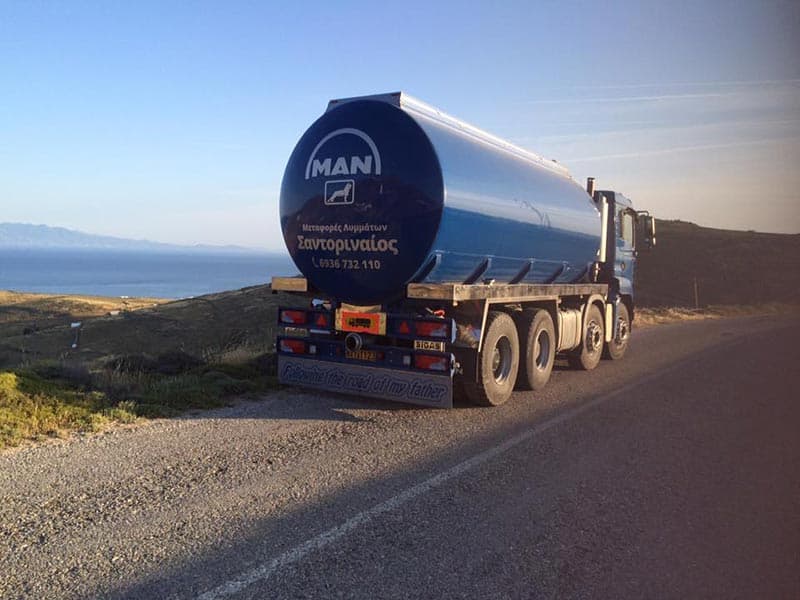
Our driver parks as close to the cesspit as the road allows and runs the vacuum hose to the lid. We empty the tank, check whether the problem was simply a full cesspit or a blockage in the pipes, and clear the blockage if needed. We then tell you what we found and what we think caused it.
Everything we pump out is transported in our tanker and delivered to a licensed facility: the licensed municipal wastewater treatment plant of Mykonos (DEYA Mykonou). We do not leave until the immediate problem is under control. For major interior damage, such as soaked floors or furniture, you may also need a specialist cleaning or restoration company.
After the emergency: preventing the next one
Most sewage emergencies we see in Mykonos happen in July and August, in full villas whose tank was not emptied before the season. A few simple habits prevent most of them.
- Empty the cesspit before the season, in April, May or early June.
- Agree a regular emptying schedule for busy months, timed with guest changeovers.
- Keep pool backwash, outdoor showers and rainwater out of the cesspit where possible.
- Put a note in bathrooms asking guests not to flush wipes, sanitary products or paper towels.
- Ask staff to report slow drains, gurgling or smells the same day.
- Save +30 693 673 2110 in the phone of everyone who looks after the property.
Frequently asked questions
What should I do if my cesspit overflows in Mykonos?
Keep people away, stop all water use in the house, keep electrical appliances away from water and do not add chemicals. Then call or WhatsApp Metafores Lymaton Santorinaios on +30 693 673 2110 with your location pin; we answer 24/7.
Is there an emergency sewage service in Mykonos?
Yes. Metafores Lymaton Santorinaios handles sewage emergencies across Mykonos 24/7 and usually reaches you within 1 to 2 hours. Call or WhatsApp +30 693 673 2110.
Is sewage backup dangerous?
Yes, raw sewage contains bacteria and viruses, and cesspit gases can be dangerous in enclosed spaces. Keep children and pets away, wear gloves, ventilate, and never enter or lean into an open cesspit.
Should I pour bleach or chemicals into an overflowing septic tank?
No. Chemicals do not empty a full tank, they can react with each other and they make the work less safe. A full septic tank needs to be pumped out by a vacuum tanker.
What information should I send when I call for an emergency sewage truck?
Send your location pin, a short description of the problem, access details such as gate codes and road width, where the cesspit lid is and the phone number of the person on site. Photos help us bring the right equipment.