Key takeaways
- An absorption cesspit (απορροφητικός βόθρος) has an open or permeable bottom, so liquid drains into the ground and solids stay behind.
- A sealed tank (στεγανός βόθρος) is watertight: everything that goes in stays in, so it needs the most regular emptying.
- A septic tank (σηπτική δεξαμενή) settles and partly digests solids; the sludge still has to be pumped out from time to time.
- Rocky ground and thin soil, common on Mykonos, mean absorption pits often fill much faster than their owners expect.
- Before buying or renting, ask which system the property has, when it was last emptied and where the lid is.
Absorption cesspit (απορροφητικός βόθρος): how it works and when it needs emptying
Many houses, villas and hotels on Mykonos are not connected to a central sewer and rely on their own system under the garden, the driveway or a terrace. A long-established type, still found under many older properties, is the absorption pit: a pit with permeable walls or an open bottom, where liquid seeps into the surrounding ground and solids collect at the bottom.
An absorption pit relies on the ground to do part of the work. As long as the soil around it can take the liquid, the pit only fills slowly with sludge and needs emptying less often than a sealed tank.
The problem is that this changes over time. Fine solids and grease gradually clog the walls and the ground around the pit, and absorption slows down. A pit that once needed a tanker rarely can start filling every few weeks in summer. How often yours needs emptying depends on the ground, the size of the pit and how many people use the property, so the best guide is its own history: if it is filling faster each year, the absorption is failing.
Sealed tank (στεγανός βόθρος): predictable, but it needs a schedule
A sealed tank is a watertight concrete or plastic tank. It holds every litre of wastewater from the property until it is pumped out. That makes it the cleanest option for the ground and groundwater, and the easiest to plan around, because it fills at a steady rate that follows occupancy.
It also means it needs the most regular emptying of the three. A busy villa or hotel in July and August fills its sealed tank much faster than in winter, so emptying is best tied to guest numbers and changeovers rather than to the calendar.
Septic tank (σηπτική δεξαμενή): treatment first, emptying still needed
A septic tank, usually with two or more chambers, is a small treatment step. Heavy solids sink and form sludge, grease and light material float as a crust, and bacteria break down part of the organic matter. The liquid in the middle leaves the tank and goes to an absorption pit, a drainage field or a further treatment unit.
The sludge and crust do not disappear. They build up until they start to escape with the liquid and clog whatever is downstream. Regular pumping and cleaning keeps the chambers working and protects the soakaway. Some newer properties have a full biological treatment unit (βιολογικός καθαρισμός) instead, which also produces sludge that needs removing.
Why rocky ground on Mykonos matters, and what it means for groundwater
Mykonos is a dry, rocky island, and much of it is granite with only a thin layer of soil on top. Solid rock does not absorb water, and thin, compacted soil only takes a limited amount. That is why many absorption pits on the island drain poorly from day one, or work at first and then slow down as the little soil around them clogs. In practice, an absorption pit on rocky ground often has to be emptied almost as often as a sealed tank.
Where the liquid cannot go down, it can travel sideways along the rock and surface lower down the slope. Near wells, boreholes, the coast or neighbouring properties, a poorly working absorption pit can carry bacteria and nutrients into water that people and nature depend on. Sealed tanks and well-maintained septic systems keep that risk much lower, as long as the waste is collected and taken to a proper facility.
Which system is allowed, especially for new buildings and for properties near the sea or water sources, is decided by the authorities and the rules can change. Check the current requirements with your engineer or the municipality before you build or change a system.
Warning signs that your system has a problem
Whatever type you have, the warning signs are similar. The earlier you call, the more likely it is a simple emptying rather than an emergency.
- Slow drains, gurgling toilets or water rising in a shower tray or floor drain.
- Sewage smells in the garden or near the lid, often worse in the evening or on still days.
- Wet, soggy or unusually green patches near the pit or further down the slope.
- A tank that suddenly fills much faster than in previous years, which usually means an absorption pit is losing its absorption.
- A so-called sealed tank that never seems to need emptying. It is probably not sealed and is leaking into the ground.
Buying or renting a property on Mykonos: what to ask
The wastewater system is easy to forget when you are looking at views and pools, but it affects running costs and the guest experience. Ask these questions before you sign.
- Which system does the property have: absorption pit, sealed tank, septic tank or biological treatment unit?
- When was it last emptied, and how often was it emptied last summer? Ask for receipts if available.
- Where exactly is the lid, and can a tanker reach it? Check the road, the gate and the driveway.
- Have there been overflows, smells or blockages, and what was done about them?
- Does the system match the building permit and current rules? Your engineer or lawyer can check this.
How we service each type
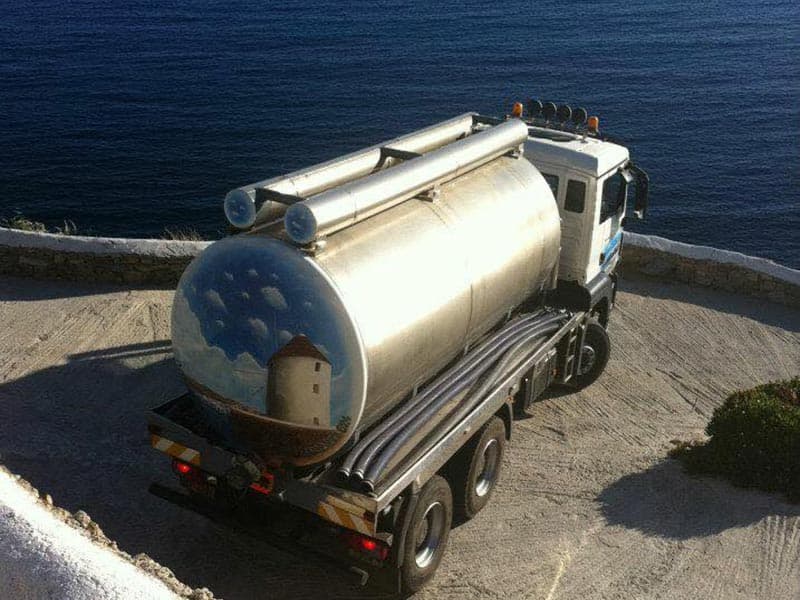
Metafores Lymaton Santorinaios has emptied cesspits and septic tanks on Mykonos for 30+ years, from Chora and Tourlos to Ano Mera, Ornos and Kalafatis. We empty sealed tanks and absorption pits, pump out and clean septic tank chambers, remove sludge from treatment units, and clear blocked drains between the house and the tank.
If you are not sure what you have, we can usually tell when we open the lid and empty the tank. We then suggest a sensible emptying routine for your property. Everything we collect is delivered to a licensed facility: the licensed municipal wastewater treatment plant of Mykonos (DEYA Mykonou). Send a WhatsApp with your location pin to +30 693 673 2110 to book.
Frequently asked questions
What is the difference between an absorption cesspit and a sealed cesspit?
An absorption cesspit lets liquid soak into the ground and keeps the solids, while a sealed cesspit is watertight and holds everything until a vacuum tanker empties it. Sealed tanks need emptying more regularly but protect the ground and groundwater better.
Why does my absorption cesspit in Mykonos fill up so quickly?
Much of Mykonos is rocky ground with thin soil, which absorbs little water, and the ground around an absorption pit clogs over time. When absorption fails, the pit fills almost like a sealed tank and needs more frequent emptying.
Does a septic tank need to be emptied?
Yes. A septic tank breaks down part of the waste, but sludge and grease build up and must be pumped out regularly, otherwise they clog the soakaway or treatment stage after it.
How do I know what type of cesspit my Mykonos villa has?
Check the building plans, ask the owner or builder, or look at the emptying history: a tank that fills at a steady rate with occupancy is usually sealed. Metafores Lymaton Santorinaios can identify the system when emptying it; call or WhatsApp +30 693 673 2110.
Who empties absorption pits and septic tanks in Mykonos?
Metafores Lymaton Santorinaios, a family business based in Marathi since 1995, empties absorption pits, sealed tanks and septic tanks across Mykonos with vacuum tankers. Call or WhatsApp +30 693 673 2110.