
Key takeaways
- There is no single interval: tank volume, guests per week and tank type matter more than the calendar.
- A sealed cesspit fills in direct proportion to water use; an absorbing pit depends on the soil and slows down as it clogs.
- Always empty before the first guests arrive in May or June, so the tank starts the peak season empty.
- A fully booked villa in July and August may need emptying several times; plan the dates around changeovers.
- Warning signs such as slow drains, gurgling or smells mean the tank is overdue. Do not wait for an overflow.
Why there is no single answer
Owners often ask us for one number, such as once a year. The honest answer is that a two-bedroom house used by its owner in spring and a six-bedroom villa rented every week from June to September are completely different situations, even on the same road.
What fills a tank is the water that goes into it. Every shower, toilet flush, washing machine cycle and dishwasher load ends up in the cesspit. So the question is really: how much water does the house send into the tank each week, and how much can the tank hold?
The factors that decide how often you need emptying
When we inspect a villa, these are the things we look at before suggesting a schedule.
- Tank size: older Mykonos houses often have small pits built decades ago; newer villas usually have larger tanks. Many owners do not know the volume, which is one reason an inspection helps.
- Number of guests: a villa sleeping ten produces far more wastewater than one sleeping four. Count beds, not bedrooms.
- Occupancy in July and August: back-to-back bookings with full houses are when tanks fill fastest and when an overflow does the most damage.
- Absorption pit or sealed cesspit: an absorbing (porous) pit lets some liquid soak into the ground, while a sealed tank holds everything until it is pumped out.
- Water use habits: long showers, frequent laundry for linen changes and dishwashers running twice a day all add up.
- What is connected: pool backwash, outdoor showers and rainwater should normally not go into the cesspit. If they do, the tank fills much faster.
Sealed cesspit vs absorbing pit
A sealed cesspit (often called a septic tank by English-speaking owners) is a closed container. Nothing leaves it except through our hose, so it fills at the same rate the house uses water. The schedule is predictable once you know the volume and occupancy.
An absorbing pit, common in older properties, lets part of the liquid drain into the surrounding ground. At first it can go a long time between emptyings. Over the years the soil around it clogs with sludge, absorption drops, and the pit starts filling much faster. Rocky ground, which is common on Mykonos, also limits absorption. If your pit used to last all summer and now does not, this is probably why.
If you are unsure what type you have, we can tell you on the first visit by looking at how the tank is built and how it behaves when pumped.
Rough rule of thumb (a starting point, not a promise)
The figures below are only a rough guide for planning. Every property is different, and we always advise a schedule after we have seen the tank, its volume and how the villa is used.
- Owner-occupied house, used a few weeks a year: often one emptying a year, ideally before the summer.
- Small rental villa (up to about 4 guests), occupied most of the season: usually one emptying before the season and at least one during July or August.
- Medium villa (about 6 to 8 guests) with weekly bookings: before the season, then roughly every few weeks in peak months, depending on tank size.
- Large villa (10 or more guests) or a property with staff quarters: may need emptying weekly or every two weeks in July and August; a regular schedule is the safest option.
- Any property with an older absorbing pit that has started to fill quickly: treat it as a sealed tank and plan more frequent visits.
Warning signs that the tank is overdue
Do not wait for sewage on the terrace. These signs usually show up first, and when guests notice them it is already late.
- Sinks, showers or toilets draining more slowly than usual, especially on the lowest floor.
- Gurgling sounds from drains or toilets after flushing.
- Sewage smell near the cesspit lid, in bathrooms or around the garden.
- Wet patches, unusually green grass or damp ground above or near the tank.
- Water backing up into the shower tray or floor drain.
- Guests mentioning a smell in a review or message: take it seriously and call us the same day.
Empty before the season, not during the first booking
The single most useful habit is a pre-season emptying in April, May or early June, before the first guests arrive. The tank then starts the busy months empty, and you have a clear baseline: you know the date it was emptied and can see how quickly it fills.
A pre-season visit is also the moment to check that the lid is accessible, that nothing heavy has been built or planted over it during winter works, and that the access road is clear for a tanker. In high season, roads in areas like Platis Gialos, Ornos and Agios Stefanos are busy, and villa driveways are often narrow, so early planning saves stress for everyone.
What property managers should put in the calendar
If you manage one or more villas, a simple routine avoids most emergencies.
- Book a pre-season emptying for every property before the first arrival.
- Keep a note of each tank's approximate volume and the date of every emptying, so you can see the real fill rate.
- In July and August, schedule emptying on changeover days, between check-out and check-in, so there is no truck in the drive while guests are on holiday.
- Ask cleaners and housekeepers to report slow drains or smells straight away.
- Tell guests not to flush wipes, sanitary products or kitchen grease; a short note in the bathroom helps.
- Keep our number, +30 693 673 2110, in the house manual for your on-site staff.
- Consider a regular maintenance schedule with us for larger villas, so dates are fixed in advance.
How to book an emptying with us
Call or send a WhatsApp message to +30 693 673 2110 (second line +30 693 227 7624) with the villa's location pin, a rough idea of the tank size if you know it, and any access details such as gate codes or narrow roads. We work Monday to Saturday, 07:00 to 21:00 and cover all of Mykonos, from Chora and Ano Mera to Kalafatis, Elia and Tourlos.
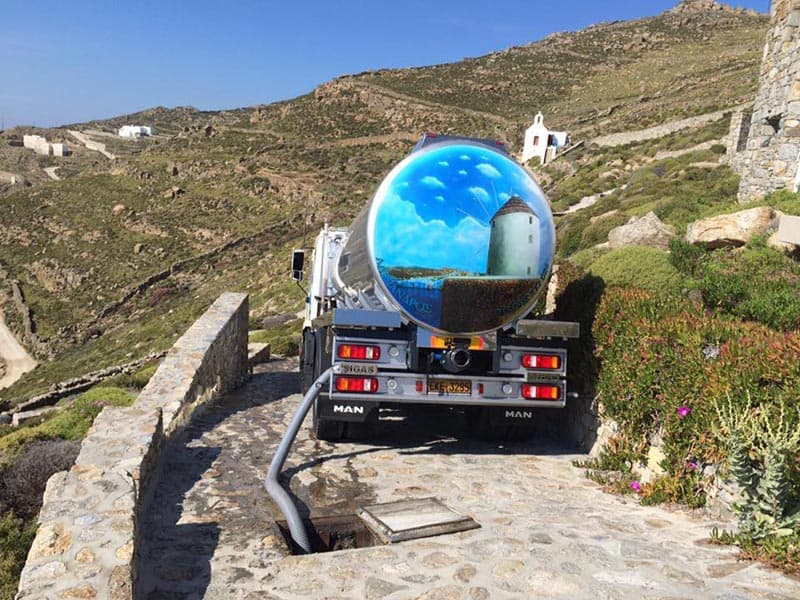
We come with a vacuum tanker, empty the tank and deliver the waste to a licensed facility: the licensed municipal wastewater treatment plant of Mykonos (DEYA Mykonou). On the first visit we can tell you roughly how often your tank is likely to need emptying, and set up a schedule for the season if you want one.
Frequently asked questions
How often should a septic tank be emptied in a Mykonos rental villa?
It depends on tank size, number of guests and whether the pit is sealed or absorbing. Most rental villas in Mykonos need at least one emptying before the season and one or more in July and August; large, fully booked villas may need it every week or two. An inspection is the best way to set the right interval.
When is the best time to empty a cesspit in Mykonos?
Before the season starts, in April, May or early June, so the tank is empty when the first guests arrive. During July and August, book emptying on changeover days to avoid disturbing guests.
How do I know if my villa's septic tank is full?
Common signs are slow drains, gurgling toilets, sewage smells near the lid or in bathrooms, and wet ground above the tank. If you notice any of these in Mykonos, call Metafores Lymaton Santorinaios on +30 693 673 2110 the same day rather than waiting for an overflow.
Should the pool and outdoor shower drain into the cesspit?
Normally no. Pool backwash, outdoor showers and rainwater add large volumes of water and can fill a cesspit very quickly. If they are connected to your tank in Mykonos, expect to need much more frequent emptying.
How much does it cost to empty a septic tank in Mykonos?
The price depends on the volume, access to the property and the distance. Call or WhatsApp us with the location for a quote.